Publication date: october 2026.
Choose payment by check (for France) or credit card.
Send it by mail; it will only be cashed upon the book's release.
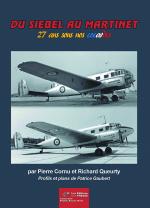
Between January 15, 1937, the date of the "Beech 18" prototype's maiden flight, and November 26, 1969, when the final three units rolled off the line, some 8,000 Beech 18s of all variants were produced at the Wichita plant.
In France, the "Beech adventure" began in April 1942 with "18S" No. 266, gifted to the FAFL (Free French Air Forces) by Count Jacques-Édouard de Sieyes. This first aircraft served with the Artois Group based in Pointe-Noire. It was not until September 28, 1944, that an initial batch of 15 "UC-45Fs", supplied under the US Mutual Defense Assistance Program (MDAP/PAM), was delivered to France at Mouzaïville to equip the GT 2/15 Anjou. Further deliveries followed in October and December 1944, bringing the total number of aircraft assigned to the Anjou to 26. Deliveries continued in parallel, with a final total of 49 units supplied by the United States. Four units were purchased from civilian sources between November 1953 and June 1959, four brand-new Super 18s were bought in May 1955, and in 1962, Canada transferred 29 "Expeditors" (3T and 3N variants) to France.
Units were equipped as deliveries arrived: CIET 340 in October 1948, GLAM in September 1948, GAEL in May 1948, ELA 41 in May 1969, ELA 43 in May 1964, ELA 44 in April 1964, ELA 52 in November 1954, ELA 55 in June 1957, GLA 45 in early 1956, EARS 99 in June 1969, CEAM in September 1958, Air Base 107 in January 1972, Air Base 177 in 1968, the CEV in June 1947, and the Air Attaché's aircraft at the French Embassy in Washington in the early 1950s… The Beechcraft flew under French Air Force roundels from April 1942 until May 1972, when they were permanently retired from service.
For its part, French Naval Aviation (Aéronautique Navale) received 20 "SNB-5s" from the United States before 1958 and 25 "JRB-4s" before 1959. These 45 Beechcraft were operated until 1972 by Escadrilles 2.S, 10.S, 32.S, 50.S, 55.S, and 56.S, as well as by the ERC, the Algiers Liaison Section, the Morocco Liaison Section, and the Cuers Naval Air Station (BAN).
To be as precise as possible, this book also includes government-operated aircraft, namely: the Saint-Yan Air Training Service, which operated 15 aircraft; the Lannion CNET, which operated two; and the High Commission Escadrille in Indochina, which operated 10. Several of these Indochina aircraft were detached to ELA 52 in Tan Son Nhut for electronic eavesdropping and tracking of Viet Minh units prior to the delivery of MDAP-FE (PAM-EO) aircraft in 1954. Additionally, two were assigned to the High Commissioner in Cameroon, two to the High Commissioner in French West Africa (AOF), one to the Public Works Directorate in Rabat, one to the Ubangi-Shari Territory, one to the Chad Territory, one to the Réunion Department, and four to the Governor of Niger.
After thirty years of service under our roundels, this faithful servant of the Air Force, Naval Aviation, and French Government Administration fully deserved a dedicated book, as it possessed all the qualities of a perfect aircraft: speed, elegance, and versatility.