Attention : Ce produit est un contenu numérique.
- Accès : Il est uniquement consultable depuis votre Espace Personnel sur notre plateforme.
- Téléchargement : Le produit est non téléchargeable, pour garantir le droit d'auteur, aucun fichier ne pourra être sauvegardé sur votre appareil.
Digital version of this book
“They went off to fight, and God blessed them / They went off to fight, and this supreme surge / Of hope and faith, despite all the blasphemies / Must one day be credited to them at the fair price / Of all their youth sacrificed for the country.”
Such is the beginning of a poem written by André Paquot, a young Belgian who fled his occupied country to join the RAF. A few months later, in 1944, he was killed at the controls of his Typhoon. Like many of his compatriots engaged in British aviation, he did not live to see the end of the war.
The history of Belgian volunteers in the Allied air forces during the Second World War remains to this day only a draft, given its complexity stemming from the great diversity of individual fates. Unlike the French, Czechs, Poles, Norwegians, etc., who tended to regroup in 'ethnic' units, the Belgians—coming from a nation very often occupied—balked at authority and therefore had no qualms about 'scattering' within the RAF. Some even went so far as to flee enlistment or transfer into units intended to be purely Belgian. Although this small country committed no fewer than 29 airmen in the Battle of Britain in September 1940 (15 in Fighter Command and 14 in Coastal Command), despite this initial record, the 'Belgian Section of the RAF' was never able to control and gather all its members scattered to the four corners of the globe. Belgian airmen fought (or perished) over France, Italy, the Azores, Canada, Germany, Poland, Romania, Libya… and even over the Indian subcontinent.
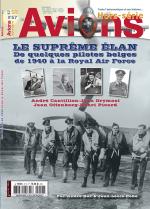
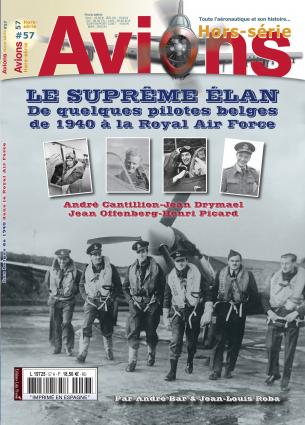
This work is admittedly fragmentary, but nevertheless aims to contribute to a history yet to be written. It brings together four fates of Belgian airmen who, from the fall of France in June 1940, were among the first to reach Great Britain to continue the fight:
Jean Offenberg, a fighter pilot in the Aéronautique Militaire, was quickly deployed within Fighter Command. He distinguished himself notably during the Non-Stop Offensive of 1941, led a British Squadron into combat, but was killed in 1942 in a mid-air collision.
Jean Drymael, a competent and highly promising aeronautical engineer, was eager to fight in the skies. However, he operated for only a short time in Coastal Command before disappearing at sea off Brest.
André Cantillion, a young man from Wavre with a self-effacing appearance, chose to fly in a long-range photographic reconnaissance unit. He took part in 34 risky and highly unpredictable missions before perishing in the Baltic.
Henri Picard, passionate about nature and animals, joined No. 350 (Belgian) Squadron. Captured after being shot down over the English Channel, he took part in the 'Great Escape' but was quickly recaptured and murdered.
Each biography aims to recreate the personality of these four airmen, who had very different experiences and ends, using writings, documents, letters, logbooks, and eyewitness accounts. This makes it possible to bring to life the commitments, ideals, aspirations, feelings, and moments of joy or doubt of these four young men. May the reader thus understand what this supreme surge was for them—one that influenced and forged their destinies.

 Voir format papier