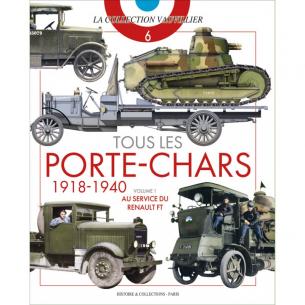
The tank transporter truck reconciles two modes of land transport that—at the height of the Great War—were considered contradictory: tracks, for navigating varied or rugged terrain, and wheels, for travel along established roads.
The first vehicles in this category, which emerged in 1917, were essentially "caterpillar" carriers—often heavy semi-trailers designed to haul large tracked machines weighing up to 14 tons. However, it was the advent of the Renault FT light tank that truly spurred the development of the dedicated tank transporter. No longer relying on the ad hoc, ill-suited, and oversized vehicles used during the early months of the war, the military moved toward a coordinated weapons system: within the tank regiments themselves, Renault FTs were paired with relatively standard road-going trucks, each capable of easily carrying a 7.5-ton load.
This first volume examines models from a wide range of manufacturers—from well-known names like Renault and Berliet to more obscure ones like Dewald, as well as mid-sized firms such as Laffly, Saurer, and Somua. Between 1918 and 1940, these vehicles provided the Renault FT with the operational mobility it otherwise lacked; while the small tank was capable of traversing rough terrain, it was too slow and too fragile to move long distances over roads on its own tracks.