

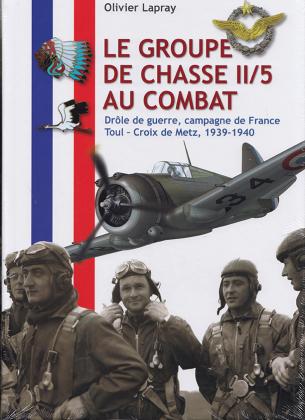
Upon general mobilization, Fighter Group II/5 departed from Reims for the Toul-Croix de Metz airfield on August 28, 1939. Commanded by a former World War I ace with 12 aerial victories, the group consisted of N124 "Lafayette," a squadron of American volunteers from 1916, and SPA167, a former squadron of the Stork Group from 1918. Aboard their Curtiss aircraft, which had arrived a few months earlier from the USA, the pilots of GC II/5 played a significant role in what some would call the Phoney War, providing air cover for the Third Army in the Moselle region, notably during the victorious engagement of nine Curtiss H-75s against 27 Messerschmitt Bf 109s, and later during the fierce air battles of the Battle of France over Lorraine and Champagne.
The last fighter group to withdraw from its initial staging area, its mechanics were attacked by the Luftwaffe on June 13, 1940. GC II/5 was cited in the Army Orders as "an elite group which, thanks to the consummate experience of its leader, Commandant Hugues, and the skill and indomitable courage of its pilots, consistently managed to impose its superiority on the enemy and achieved magnificent results."
In ten months of aerial combat, Fighter Group II/5 had shot down 51 enemy aircraft, while 22 Curtiss fighters were either shot down or forced to make emergency landings due to German fighters, the gunners of the bombers they attacked, and flak. Seven of its pilots and four soldiers were wounded, and three soldiers and two pilots were killed: Sergeant Magnez and Lieutenant Houzé.
Giving a significant portion to their testimonies, this work is dedicated to the memory of these pilots, mechanics and aviators who were engaged in combat from September 1939 until the last days of June 1940, with much pain but also great successes, yet in vain.