
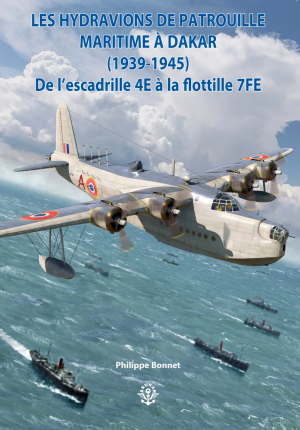
In late August 1939, just days before the declaration of war on Germany, the Navy deployed the three Latécoère 302s—and later the Latécoère 301—of Escadrille E4 to Dakar, tasking their crews with monitoring shipping in the South Atlantic and conducting reconnaissance missions off the coast of West Africa. From February 1, 1940, Loire 130s from units 8S3, 18S, and SS4E arrived to bolster these efforts and help monitor the approaches to Dakar. Following the Armistice of June 24, 1940, and the subsequent Royal Navy attacks on French ships anchored at Mers el-Kébir and Dakar, British and French forces faced off in French West Africa (AOF) until November 1942. Harsh weather conditions soon took their toll on the elegant Latécoère 302s; they were initially supplemented by the Potez-CAMS 141 Antarès and later replaced by other types of seaplanes, such as the Lioré & Olivier H470, the Latécoère 523 Altaïr, and the Latécoère 611 Achernar. In late November 1942, the French armed forces stationed in Dakar sided with the Allies following the landings in French North Africa. To help protect Allied shipping, Naval Aviation units based at Dakar Bel-Air and Dakar-Ouakam secured the loan of several aircraft and seaplanes from the British. Meanwhile, starting in March 1943, a contingent of French sailors was sent to England, Northern Ireland, and Scotland to undergo training on Short Sunderland and Vickers-Armstrong Wellington aircraft. Under the authority of Coastal Command West Africa, and as part of Wing 295, the Sunderlands of the 1FE/7FE flotilla carried out convoy escort missions and anti-submarine patrols from August 1943 until May 1945.